Off the remote coast of Western Australia, the world's largest fish gathers each year near a fringing reef you can reach from the beach. Strict rules keep encounters calm for sharks and swimmers.
Ningaloo Reef runs for about 300 kilometres along the coast of Western Australia, far north of Perth. Unlike the Great Barrier Reef, it is a fringing reef, lying close to shore, and in many places you can walk off the beach and snorkel over coral. The Ningaloo Coast is a UNESCO World Heritage Site, and much of the reef lies within Ningaloo Marine Park.
Each year, whale sharks gather along the outer edge of the reef. They are the largest fish in the sea, filter feeders that live on plankton and small fish, and they are harmless to people. Swimming alongside one is the reason many people make the long journey.
The season
Whale sharks are usually seen at Ningaloo from about March to July, sometimes later. Their arrival is linked to plankton blooms along the reef after the coral spawns in autumn. Numbers vary from year to year, and no sighting is ever guaranteed, though most trips in the peak months find sharks.
Ningaloo is also visited by humpback whales, roughly from June to November, and manta rays are seen through much of the year, especially around Coral Bay. Turtles are present all year, with nesting on the beaches in the southern summer.
How swims work
In Ningaloo Marine Park, swimming with whale sharks is done only on licensed boat trips from Exmouth and Coral Bay. Spotter aircraft search for sharks, and when one is found, the boat positions ahead of it and a small group of swimmers enters the water, guided by staff. The shark swims past, and the group watches and swims alongside for as long as it allows.
A good level of comfort in open water helps. The sea can be choppy outside the reef, and the sharks move steadily, so expect to swim. Life jackets or flotation aids are usually available for less confident swimmers.
A typical day starts early and includes a snorkel on the reef while the spotters search, then the shark swims once one is found. Days at sea are long, and seasickness can be a problem on the outer side of the reef. Eat a light breakfast and take a remedy in good time if you are prone to it.
Another wild place: The Galapagos Islands
Swimming rules in general
The rules are set by the Western Australian Department of Biodiversity, Conservation and Attractions, and they cover how boats approach, how many people may be in the water and how close swimmers may come. Rules are reviewed, so read the current version before your trip. In general terms:
- Keep the minimum distances from the head, body and tail that the rules set.
- Never touch or ride a whale shark, or block its path.
- Do not use flash photography or underwater motor devices.
- Stay with your group and follow the crew's directions.
- Get out of the water when told to, so that the shark can move on.
The photograph above shows a whale shark feeding; it was not taken at Ningaloo, but the animals there look and behave much the same.
The reef from the beach at Coral Bay
Coral Bay is a small settlement on a sheltered lagoon at the southern end of the reef. Here, coral grows only a short swim from the sand, and you can snorkel from the beach over coral gardens full of fish. It is one of the easiest places in the world to see a healthy reef without a boat.
- Enter and leave the water over sand, not coral.
- Do not stand on or touch coral; it is alive and breaks easily.
- Watch for currents, especially at the edges of the lagoon and near channels, and read the signs.
- Protect yourself from strong sun with a rash vest and hat.
Turtles
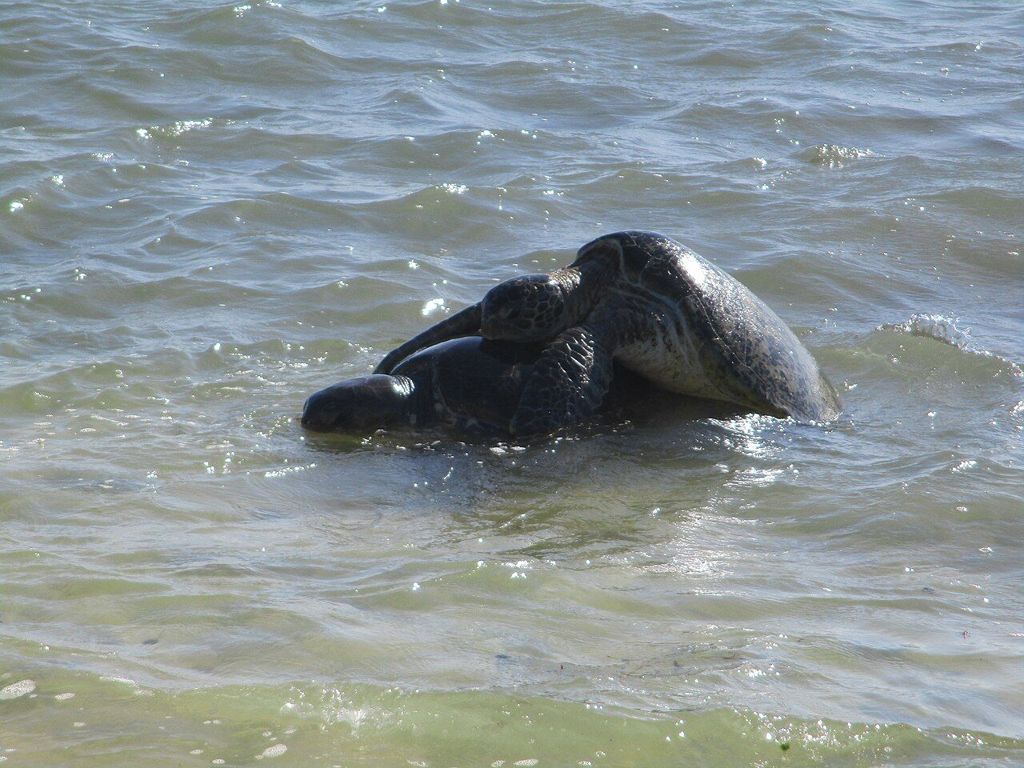
Green, loggerhead and hawksbill turtles live along the Ningaloo Coast and come ashore to nest on its beaches, mainly from late spring to late summer. You often see turtles in the shallows close to shore, surfacing to breathe or resting. The photograph at the top of this note shows two turtles in the shallow water along the Ningaloo Coast.
If you see nesting turtles at night, follow the local code: stay well back, keep lights off, avoid flash and never stand in front of a turtle coming ashore. Hatchlings heading to the sea should be left alone.
Turtles in the water deserve the same care. Give them plenty of room when snorkelling, do not swim above a turtle that is surfacing to breathe, and never chase one for a better photograph. A turtle that stays relaxed near you is a far better picture than one swimming away.
Remote but rewarding
Ningaloo is far from the cities of Australia. Exmouth and Coral Bay are small towns surrounded by desert, the drive from Perth is long, and services are spread out. Heat, flies and long distances are part of the deal, and the coast is at its most comfortable outside the hottest summer months.
Cape Range National Park, on the peninsula west of Exmouth, protects rugged limestone gorges and a long stretch of beaches facing the reef. Several bays there offer excellent snorkelling from the shore, though some have strong drifts, and signs at each beach explain the conditions. Kangaroos and emus are common along the roads at dawn and dusk, which is one more reason to avoid driving at those times.
For another place where animals and people share the water under strict rules, see the note on the Galapagos Islands. For great whales in sheltered water, see grey whales in Baja California.
Planning notes
- When: March to July
- Getting there: Fly to Learmonth, then drive to Exmouth
- Bring: Rash vest, reef-safe sunscreen, snorkel, hat, water bottle